
Key Takeaways
|
Large Language Models have demonstrated an impressive ability to generate text, answer questions, and work through complex problems. But enterprise AI requires something more as a business agent cannot simply produce a plausible answer. It needs to work with trusted enterprise data, follow business processes, respect security policies, and take actions in the systems where work actually happens.
That changes the problem. Instead of asking an AI model only to generate an answer, enterprise AI needs to enable it to: Understand a goal → gather information → decide what to do → take action → evaluate the result → adapt if necessary.
This is the idea behind agentic AI. Salesforce Agentforce applies this approach through an architecture that combines reasoning, action, enterprise data, and guardrails. At the center of this architecture is the Atlas Reasoning Engine.
Why Enterprise AI Needs More Than an LLM
A standalone LLM is extremely capable at processing language and identifying patterns. But imagine asking an AI assistant: “Find the customers whose service cases have been unresolved for more than 30 days, determine which ones are at the highest risk, and schedule follow-up actions for the appropriate account teams.”
Answering this request requires more than generating text. The system needs to:
- Understand what the user is asking.
- Identify the relevant customer and case data.
- Retrieve accurate information.
- Apply business rules.
- Determine which actions are appropriate.
- Execute those actions.
- Check whether the actions succeeded.
- Adapt if something went wrong.
This is where an agentic architecture becomes important. Rather than treating an LLM as a standalone answer generator, Agentforce uses the model within an iterative orchestration loop.
ReAct: Reason + Act
One of the key strategies behind this approach is ReAct, short for Reason + Act. The basic idea is simple: Reason → Act → Observe → Reason again
Instead of generating a response and stopping, the agent can determine what it needs to do, execute an action, observe the result, and use that result to determine its next step. This creates a feedback loop.
- Thought
When an agent receives a request or event, it first needs to interpret the goal. It can break the request into smaller steps and determine what information or capabilities it needs. For example, if the goal is to resolve a customer issue, the agent may need to identify the customer, retrieve the relevant Case, examine previous interactions, and determine which action should be taken.
- Action
The agent then uses available system capabilities to act. In Agentforce, an action can include:
- Running a Salesforce Flow
- Executing an Apex class
- Making an API call
- Performing semantic search through Data Cloud
- Taking another configured business action
This is a major difference between a traditional chatbot and an agent. A chatbot primarily responds. An agent can act.
- Observation
After executing an action, the system receives a result. For example: Record updated successfully. Or: Query returned 0 results. That result becomes feedback for the next stage of the process.
- Reflection and Adaptation
What happens if the action doesn’t produce the expected result? Rather than simply returning an answer based on an assumption, the agent can evaluate the outcome, update its context, and determine whether another path should be attempted. This creates an iterative process: Reason → Act → Observe → Adapt → Act again. That feedback loop is fundamental to agentic behavior.
The Agentforce Atlas Reasoning Engine
Enterprise workflows require reasoning that is grounded in more than general language patterns. Business decisions need to be connected to corporate data, business processes, and deterministic guardrails. This is where the Atlas Reasoning Engine comes into the picture.
Rather than using an LLM as a standalone generator, Agentforce places the model inside an orchestration framework that combines reasoning with enterprise data and actions. The goal is to move from: “Generate a plausible answer.” to: “Determine the appropriate steps and execute the task within the boundaries of the business.”
Key Pillars of Agentforce Reasoning
- Goal-Driven Intent Parsing
The process starts with understanding the user’s intent. When a user or system triggers an agent, the Atlas engine evaluates the request to identify the underlying goal and desired outcome. An unstructured request from a user needs to be translated into a structured business objective that the agent can work toward. This is the starting point for everything that follows.
- Data Grounding with Data Cloud
An AI agent should not have to rely solely on what an LLM learned during training. Enterprise decisions need current, relevant business information. Agentforce can use Data Cloud and Retrieval-Augmented Generation (RAG) to retrieve information from enterprise data and knowledge sources. This allows the reasoning process to be grounded in relevant business information, such as:
- Accounts
- Cases
- Work Orders
- Knowledge
- Operational data
The goal is to prevent reasoning from becoming disconnected from the actual state of the business. Instead of asking: “What would normally happen in a situation like this?” the system can work with: “What is actually happening in this customer’s record right now?” That distinction is critical for enterprise AI.
- Action and Tool Selection
Once the agent understands the goal and has access to relevant information, it needs to determine what to do. This is where the ReAct loop becomes particularly important. The agent can evaluate available actions, such as:
- Executing a Flow
- Calling an Apex class
- Making an API call
- Retrieving additional information
- Sending an email
- Updating a record
The agent determines an appropriate sequence of actions to move toward the desired outcome. This transforms the AI from a system that simply generates text into one capable of participating in business processes.
- Iterative Evaluation and Refinement
An agent does not have to assume that its first action will always succeed. After each action, it can evaluate the result against the original goal. If the result is incomplete or unexpected, the system can adjust its approach and attempt another path. This is one of the defining characteristics of agentic systems. The process becomes: Goal → Reason → Act → Observe → Evaluate → Refine rather than: Prompt → Answer
- Security, Trust, and Guardrails
Enterprise AI cannot operate without boundaries. An agent may have access to sensitive customer, financial, operational, or employee information. It therefore needs to operate within the organization’s existing security and governance framework. The Agentforce architecture incorporates the Einstein Trust Layer and Salesforce security controls to help ensure that agents operate within appropriate permissions and data-access boundaries. The principle is straightforward: An agent should not be able to reason over or act on information that it is not authorized to access.
This is especially important in enterprise environments, where a technically correct answer can still be unacceptable if it exposes information to the wrong person or performs an unauthorized action.
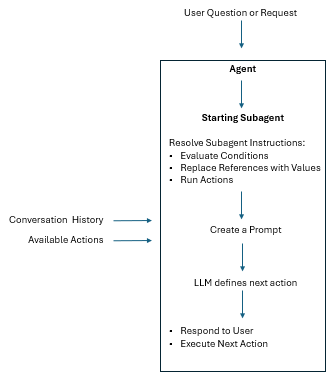
Step-by-Step: How Atlas Processes a Request
To understand how this comes together, consider the lifecycle of a request.
Step 1: The User Makes a Request
A user enters a question, instruction, or request. For example: “Find the open cases for this customer and identify the next best action.”
Step 2: The Agent Routes the Request
The agent routes the request to the appropriate starting subagent. The selected subagent provides the context and instructions required to handle the request.
Step 3: Instructions Are Resolved
Before sending the request to the AI model, the system resolves the instructions needed to execute the task. This can include:
- Evaluating conditional statements
- Replacing variable references with their values
- Determining available actions
- Running configured actions
Step 4: The Prompt Is Constructed
The system combines the resolved instructions, the user’s conversation history, and the actions available to the agent. That information is then provided to the LLM.
Step 5: The LLM Determines the Next Step
The model determines what should happen next. It may:
- Respond directly to the user and close the loop.
- Execute an action and continue the reasoning process.
If an action is executed, its result becomes part of the feedback loop, allowing the agent to continue toward the goal.
From Prediction to Goal-Directed Execution
This represents an important shift in how we think about enterprise AI. A traditional LLM can be remarkably good at generating a response based on patterns it has learned. An agentic system adds another dimension: It can reason about what needs to happen next and interact with the systems required to make it happen. The difference can be summarized simply:
| Traditional LLM | Agentic AI |
|---|---|
| Generates a response | Works toward a goal |
| Primarily text-based | Can take actions |
| Relies heavily on prompt context | Can retrieve external information |
| One-shot interaction | Iterative feedback loop |
| Limited ability to affect systems | Can execute configured business actions |
| General knowledge | Grounded in enterprise data and processes |
The real power comes from combining these capabilities rather than relying on any one of them in isolation.
Why This Matters for Enterprise AI
The debate about whether AI “actually reasons” can become philosophical very quickly. But for businesses, a more practical question matters: Can the system reliably reason through a task and execute the right actions within the boundaries of the organization?
That requires more than an LLM. It requires:
- Reasoning strategies to break down complex goals.
- Enterprise data to ground decisions in reality.
- Tools and actions to execute work.
- Feedback loops to evaluate outcomes.
- Security and guardrails to keep the system within defined boundaries.
This is the significance of architectures such as Agentforce and the Atlas Reasoning Engine. They do not attempt to make an AI system think exactly like a human. Instead, they combine statistical AI capabilities with structured orchestration, enterprise data, business actions, and governance to create a system capable of performing increasingly sophisticated work.
Conclusion
So, does Agentforce actually reason? The more useful answer may be: it is designed to perform reasoning-like work within a structured enterprise framework. An LLM provides the language and pattern-recognition capabilities. ReAct provides an iterative Reason + Act framework. Data Cloud provides grounding in enterprise information. Actions connect the reasoning process to real business operations, and security and trust mechanisms provide the boundaries within which the agent can operate.
The result is a very different model of AI. Instead of simply asking an AI: “What is the answer?”, we can ask: “What is the goal, what information do you need, what should you do next, and did it work?” That shift from generating answers to pursuing goals is at the heart of agentic AI, and it may matter much more than whether we call what happens inside the system “true reasoning.”
Frequently Asked Questions (FAQs)
- What is the Agentforce Atlas Reasoning Engine?
Atlas is the reasoning engine behind Agentforce that helps agents interpret requests, select actions, use data, and iteratively work toward a goal. - What is ReAct in Agentforce?
ReAct combines reasoning and action. The agent thinks through a task, takes an action, observes the result, and adapts its next step. - How does Agentforce use enterprise data?
Agentforce can use Data Cloud to ground its reasoning and responses in relevant enterprise data. - How does Atlas choose what action to take?
It evaluates the user’s intent, available instructions, context, and tools to determine the appropriate next step. - Why are reflection and iteration important?
They allow the agent to evaluate results, adapt its approach, and refine its response instead of following a fixed sequence. - How does Agentforce keep AI actions secure?
Agentforce uses enterprise security and governance mechanisms, including the Einstein Trust Layer, record-level security, sharing rules, and data masking. - How is Agentforce different from a traditional LLM?
A traditional LLM primarily generates responses. Agentforce can use reasoning, enterprise data, and tools to work toward a goal and take actions. - Why does enterprise AI need grounding and guardrails?
They help ensure AI decisions are based on trusted data and operate within defined business, security, and governance boundaries.