CNC is now a strategic enabler of business continuity, not just a technical necessity.
JD Edwards CNC Services must evolve to support hybrid, compliance-heavy, and automation-driven environments.
Emerging trends in 2025: SRE-led CNC, cloud adoption, automation, compliance-first designs, and continuous Tools management.
Enterprises still relying on traditional support risk downtime, rising costs, and compliance failures.
Choosing the right CNC services partner is critical to future-proof JDE investments.
Why CNC Still Matters in 2025
In 2025, JD Edwards EnterpriseOne remains a critical ERP backbone for thousands of enterprises worldwide. While many organizations have modernized infrastructure, the CNC (Configurable Network Computing) layer still defines performance, scalability, and compliance.
Yet, the role of CNC has evolved significantly. Once viewed as a tactical IT function, it is now a strategic enabler of uptime, automation, and digital transformation. This is why demand for JD Edwards CNC Services has surged in recent years, because enterprises can no longer afford reactive, ticket-based CNC support.
What Are JD Edwards CNC Services?
JD Edwards CNC Services refer to the specialized expertise, monitoring, and management required to keep the CNC layer running at peak performance. These services include:
Architecture & Components: Web, Enterprise, and Deployment servers
Server Management: Monitoring, patching, and incident recovery
Package Management: Builds, deployments, and upgrades
Performance Tuning & Monitoring: Ensuring speed and resilience
Database & OCM Configuration: Secure and scalable foundations
Security Administration: Compliance-ready systems management
Tools Release & ESU Management: Staying current without disruption
Troubleshooting & Logging: Rapid root cause resolution
Integration & Interfaces: Orchestrator, APIs, and third-party systems
Without robust CNC services, enterprises risk downtime, poor performance, and failed compliance audits.
Key Stats Defining CNC in 2025
Recent industry insights highlight the growing demand for advanced CNC services:
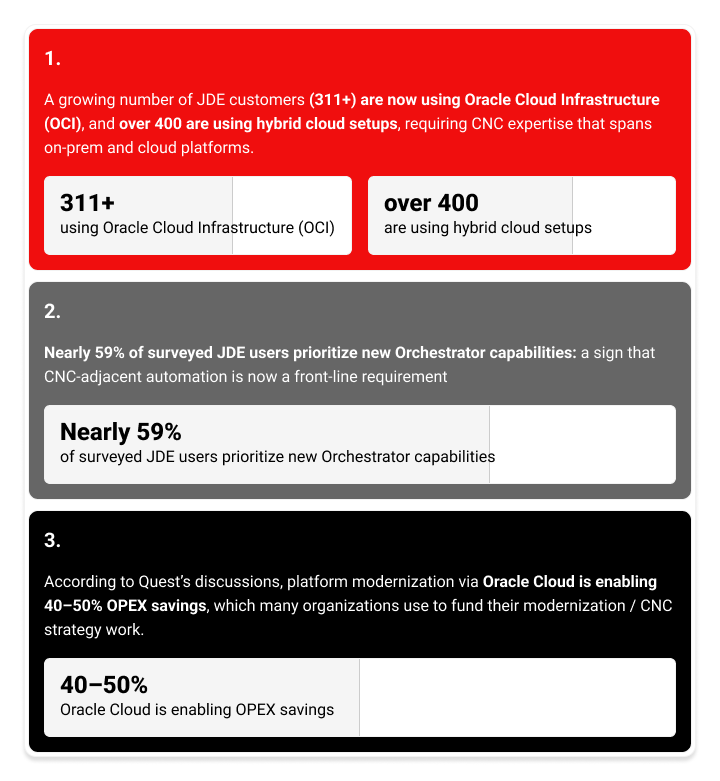
A growing number of JDE customers (311+) are now using Oracle Cloud Infrastructure (OCI), and over 400 are using hybrid cloud setups, requiring CNC expertise that spans on-prem and cloud platforms.
Nearly 59% of surveyed JDE users prioritize new Orchestrator capabilities: a sign that CNC-adjacent automation is now a front-line requirement
According to Quest’s discussions, platform modernization via Oracle Cloud is enabling 40–50% OPEX savings, which many organizations use to fund their modernization / CNC strategy work.
These numbers confirm what many IT leaders already know: CNC is no longer just maintenance, it’s a driver of resilience and modernization.
Emerging Trends in JD Edwards CNC Services
Shift Toward Proactive, SRE-Led Models Organizations are moving away from reactive ticket systems and toward Site Reliability Engineering (SRE)-led CNC services. This model emphasizes root cause prevention, optimization, and continuous improvement.
Rise of Hybrid & Cloud CNC Deployments Running JDE on OCI, AWS, or Azure is now a mainstream practice. JD Edwards CNC Services in 2025 must support hybrid environments that combine on-prem, private cloud, and SaaS integrations.
Increasing Role of Automation & AI Automation is central to CNC operations: orchestrator-driven builds, automated server recovery, RPA for repetitive tasks, and AI-enabled monitoring to detect anomalies.
Compliance-Driven CNC Strategies As industries face stricter governance, CNC services are being redefined in terms of compliance readiness. That means documentation & best practices, audit logs, and secure system administration.
Tools Release & ESU Currency as a Service Enterprises no longer want disruptive, CapEx-heavy upgrades. Instead, many rely on continuous Tools Release and ESU management built directly into CNC services contracts.
The Challenges Enterprises Still Face with CNC
Despite advances, many enterprises continue to struggle with:
Outdated, ticket-based CNC support
Unpredictable upgrade costs
Lack of database & OCM configuration expertise
Reactive performance tuning that only addresses issues after outages
Minimal automation adoption in critical CNC workflows
Shortage of specialized CNC skills in the market
Why Modern CNC Services Are Strategic, Not Tactical
Today, CNC is no longer “just IT plumbing.”
It ensures:
Business Continuity: No tolerance for downtime in 24×7 operations
Scalability: CNC must evolve with business growth and integrations
Innovation: Automation and AI readiness support future transformation
Enterprises now consider JD Edwards CNC Services a strategic investment, not an operational expense.
How Organizations Are Preparing for the Future of JD Edwards CNC
Leading JDE enterprises are:
Embedding performance tuning & monitoring into daily operations
Automating builds, deployments, and server management
Partnering with vendors who provide JDE CNC managed services across cloud, on-prem, and hybrid setups
Prioritizing security administration and compliance alignment
Leveraging predictable funding models like “Playing the Bank” to stay current without CapEx spikes
What to Look for in a CNC Services Partner in 2025
When evaluating Oracle JDE CNC service providers, look for:
Proactive, SRE-led support model
Experience across hybrid and cloud-hosted CNC environments
Deep skills in package management, integration, and logging
Proven compliance expertise (SOX, SOC-2, CFR Part 11)
Pricing transparency with built-in flex hours for emergencies
Automation-first capabilities with Orchestrator, RPA, and AI
Future-Proofing JD Edwards with Smarter CNC Services
The state of JD Edwards CNC Services in 2025 is defined by one reality: reactive models can no longer sustain modern ERP ecosystems. Enterprises need proactive CNC services that prevent downtime, enable compliance, and leverage automation to reduce costs.
By partnering with the right CNC services provider, organizations can not only protect their JDE investments but also accelerate modernization, unlock performance, and ensure their ERP is ready for the next decade of change.
The state of JD Edwards CNC Services in 2025 is defined by one reality: reactive models can no longer sustain modern ERP ecosystems. Enterprises need proactive CNC services that prevent downtime, enable compliance, and leverage automation to reduce costs.
By partnering with the right CNC services provider, organizations can not only protect their JDE investments but also accelerate modernization, unlock performance, and ensure their ERP is ready for the next decade of change.
Frequently Asked Questions (FAQs)
Why is CNC critical in JD Edwards today? Because CNC governs performance, security, scalability, and compliance across all JDE EnterpriseOne components. Without strong CNC, business continuity suffers.
What are the limitations of traditional CNC support? It’s reactive, staff-rotated, lacks automation, and often delays Tools and ESU upgrades, causing downtime and compliance gaps.
How have JDE CNC requirements changed in 2025? Hybrid cloud deployments, complex integrations, tighter compliance (SOX, GDPR), and higher user expectations demand proactive CNC support.
What should I look for in a CNC services partner? Proven JD Edwards CNC expertise, automation capabilities, SLA-backed services, and experience in Tools management.
What’s the value of moving to proactive CNC support? It reduces downtime, ensures compliance, keeps JDE current, and provides strategic optimization instead of just issue resolution.
Khushboo ChauhanKhushboo comes with a strong background enterprise technology content strategy. She leads nurturing programs across ERP modernization, tax reform readiness, and business transformation initiatives. Khushboo works closely with finance and IT leaders to deliver insight-driven content that supports informed decision-making and long-term growth.
Related Blogs
Future-Ready JD Edwards: Best Practices for API-Driven ERP Connectivity
Going Beyond Automation: Orchestration in JDE
Future Trends in JD Edwards EnterpriseOne: AI, IoT, and Beyond
We use cookies to improve your experience on our site. To consent to the use of cookies, click accept. Read More
This website uses cookies to improve your experience while you navigate through the website. Out of these, the cookies that are categorized as necessary are stored on your browser as they are essential for the working of basic functionalities of the website. We also use third-party cookies that help us analyze and understand how you use this website. These cookies will be stored in your browser only with your consent. You also have the option to opt-out of these cookies. But opting out of some of these cookies may affect your browsing experience.