
Key Takeaways
|
Client expectations, sharpened competition, and digital delivery are quickly escalating and competing with strategic priorities that struggle for your immediate attention. Whether it’s managing time-sensitive billing, handling large datasets for analytics, or ensuring secure client collaboration, applications that once sat comfortably on-prem or in lift-and-shift public cloud environments are now under scrutiny.
Today, the mission has evolved. You’ve moved from managing performance only to now expected to slash costs, accelerate delivery, ensure compliance, and maintain uptime, all while adapting to new business models powered by GenAI, real-time data, and distributed workforces.
Against this backdrop, Oracle workloads sit at the core of core operational systems. From ERP and HCM to financial reporting and compliance. But here’s the catch: hosting these workloads on generalized public cloud infrastructure has introduced hidden friction. Costs spiral. Visibility fades. Control slips.
That’s why there’s a strategic inflection point. Oracle Cloud Infrastructure (OCI) adoption is emerging as the purpose-built alternative: engineered to run Oracle workloads natively, deliver performance at scale, and give app owners a new level of architectural precision, cost predictability, and operational control.
Yet, it’s daunting to go it alone, which is why strategic partners become more than an ally and turn into a strategic advantage on your road to ready-for-what’s-next modernization.
In this blog, we’ll explore why Oracle Cloud adoption for workloads is a tactical move for app owners in the information and professional services industry, with eyes set on transforming legacy constraints into next-gen capabilities.

The Unique Workload Challenge for Information/Professional Services
For professional services firms, applications are both tools and revenue enablers. From time and expense tracking to contract lifecycle management, data visualization, and resource scheduling, these workloads must be agile, scalable, and audit-ready. Yet many of them still rely on Oracle systems deployed in rigid, aging environments or poorly optimized public clouds.
Traditional Public Cloud Isn’t Enough
App owners have learned the hard way that not all cloud platforms are created equal, especially when running Oracle workloads. Hosting Oracle databases or middleware on AWS, Azure, or GCP often means:
- Core-based over-licensing due to mismatched VM shapes and limited BYOL-friendly configurations
- Storage sprawl from redundant backups and idle dev/test environments
- Opaque cost models that make it hard to tie spend to usage or forecast OPEX
- Performance unpredictability during month-end close, audits, or client escalations
- Limited native automation for patching, scaling, or disaster recovery
The result? Even cloud-first firms in the professional services space find themselves spending more, seeing less, and wrestling with growing technical debt.
Rapid Industry Shifts
Today, the pressure is even higher. According to research, the industry is undergoing rapid shifts:
- Professional services firms are increasing digital transformation spend despite broader cost containment efforts
- Firms are expanding GenAI pilots, which require performant data infrastructure with strict compliance controls
- Hybrid work and client portal usage are driving new demands for secure, always-available access to systems
These dynamics push app owners to seek platforms that offer workload-native optimization, not just generalized elasticity.
This is where Oracle Cloud Infrastructure breaks from the pack. Unlike generalized IaaS platforms, OCI is engineered for precise Oracle workload performance, offering:
- License-aware VM shapes that reduce cost-per-core (e.g., E3/Flex/Ampere)
- Integrated database services like Autonomous Database and Exadata Cloud Service
- Built-in patching and security through Autonomous Admin and Cloud Guard
- Lower TCO by 30–40% vs. running Oracle workloads on other clouds
How Oracle Cloud Resolves Workload Challenges
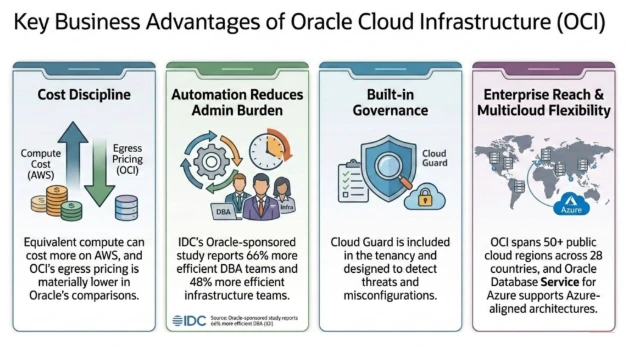
In a market where every second of uptime and every dollar spent counts, Oracle Cloud Infrastructure is reshaping the expectations for what a cloud platform should deliver, especially for Oracle workloads.
There’s a maturity leap for Oracle Cloud adoption, not just in infrastructure, but in the end-to-end experience it offers application owners responsible for performance, availability, and cost predictability. Here’s what’s changed, and why it matters now:
Autonomous Services That Work With You, Not Against You
OCI’s Autonomous Database, Autonomous Data Warehouse, and Autonomous Analytics aren’t just flashy product names. They’re real-time enablers for resource-constrained teams. These services automatically patch, tune, and secure themselves without downtime, significantly reducing admin effort while maintaining SLAs and compliance requirements.
For professional services firms juggling multiple client-facing platforms, that means fewer manual interventions, faster delivery pipelines, and reduced audit overhead.
Always-On Security and Governance, At No Extra Cost
Unlike other clouds where security tooling comes à la carte, OCI bakes in features like:
- Always-on encryption (at rest and in transit)
- Oracle Cloud Guard for threat detection and configuration drift
- Zero-trust architecture and integrated identity federation
This embedded approach simplifies compliance for firms handling sensitive financial, legal, or HR data—common in professional services.
Global Reach with Smart Interconnects
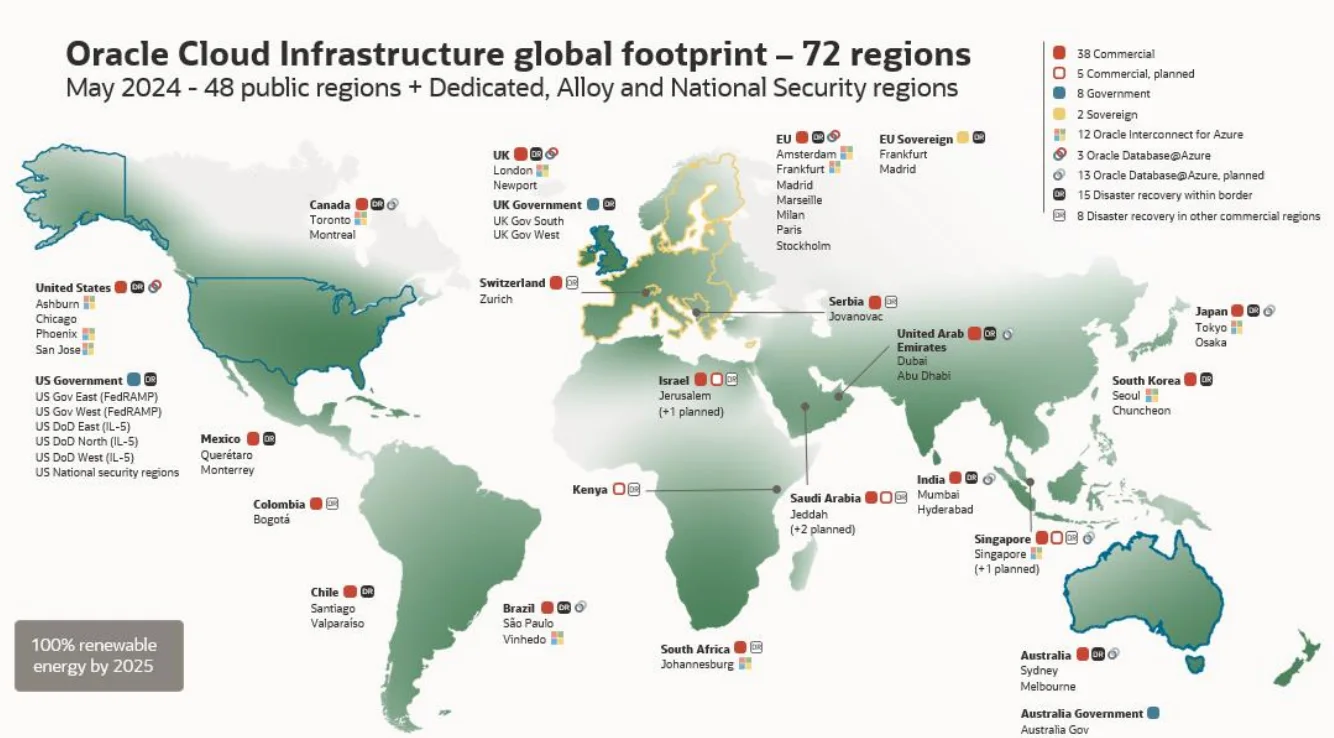
OCI’s rapidly growing global cloud region footprint and interconnects with Microsoft Azure allow application owners to reduce latency and avoid excessive data egress costs. This is especially important for distributed teams or firms with multi-cloud integrations.
FinOps Without Extra Tooling
Unlike hyperscalers that require bolt-on FinOps platforms, Oracle Cloud adoption offers:
- Telemetry-rich insights tied directly to Oracle workload behavior (e.g., per database, per transaction type)
- License-aware cost visibility so app owners can understand usage patterns and avoid overspending
- Oracle Cloud Guard and Cloud Cost Governance tools that alert teams to anomalies in cost or configuration in real time
These tools empower app owners to forecast more accurately, respond faster to anomalies, and align more tightly with finance teams on budgeting cycles.
Rightsizing and Tagging That Actually Works
Traditional tagging strategies often break under the complexity of Oracle licensing and hybrid environments. Oracle Cloud adoption, however, supports license-inventory-aware tagging, allowing app owners to map workloads to contracts, departments, and clients more clearly.
Combined with built-in autonomous rightsizing recommendations, teams can make decisions confidently about how and when to scale, shut down, or reallocate resources.
Oracle Cloud Adoption as a Strategic Lever
In the pressure-cooker environment of today, information and professional services firms are being asked to deliver more value with fewer resources, all while preserving client trust, uptime, and agility.
This is not the year to treat cloud platforms as interchangeable utilities. For application owners managing Oracle workloads, the stakes are higher, the scrutiny is sharper, and the opportunity is greater.
OCI amplifies workloads, offering a native, license-aware environment that simplifies compliance, reduces cost complexity, and supports performance at scale. While hyperscalers retrofit compatibility, OCI was purpose-built to give application owners strategic control.
So ask yourself: Should I be paying a premium to host Oracle in someone else’s house?
Or is it time to make the cloud work for us the way it was meant to?
Take back control of your Oracle workloads with the right partner, accessing cost optimization and cloud transformation expertise.
Book your free Oracle Workload Migration Assessment:
Get a custom roadmap that identifies savings opportunities, modernization potential, and license cleanups.
Frequently Asked Questions (FAQs)
- Why is there a tipping point for Oracle Cloud adoption in information and professional services?
Because the cloud decision is no longer just about where workloads run. Today, firms are being pushed to modernize AI, reduce waste, support hybrid delivery models, and maintain stronger compliance and uptime. OCI’s broader footprint, 200+ services per region, and Oracle-native workload alignment make it easier to position this as a maturity moment rather than a generic migration story. - What makes OCI a better fit for Oracle workloads than generalized public cloud platforms?
The strongest answer is that OCI is engineered around Oracle workloads instead of retrofitting support for them. Oracle highlights flexible VM sizing, lower pricing for equivalent compute in some comparisons, lower egress charges, and database services with automated management and strong availability SLAs. - Can OCI still make sense for firms that already have a multicloud strategy?
Yes — and that is worth emphasizing. Oracle Database Service for Azure is explicitly positioned as an Oracle-managed service for Azure customers, and Oracle continues to expand its multicloud posture. That helps you avoid sounding like the blog is arguing for an all-or-nothing cloud replacement. - Where do the savings and operational gains actually come from?
The cleanest answer is: rightsizing, lower networking/egress costs, less manual administration, and better Oracle workload efficiency. Oracle says AWS can cost more than 2X for equivalent compute in one example, while Oracle’s cloud economics page shows materially lower egress charges in several scenarios. Separately, IDC’s Oracle-sponsored study on Autonomous AI Database reports 66% more efficient DBA teams, 48% more efficient IT infrastructure teams, and 436% three-year ROI.