
How much technical debt is your JD Edwards environment carrying — and what could it cost you during your next upgrade, modernization initiative, or AI adoption project?
For many JD Edwards organizations, technical debt accumulates gradually. Undocumented customizations, aging integrations, and gaps in environment management can become increasingly difficult to address as business requirements evolve.
The challenge is that these issues often remain hidden until an upgrade, system change, security concern, or critical resource departure exposes them. Without a structured assessment, teams may struggle to understand where the greatest risks lie and which issues deserve attention first.
Common questions JDE teams should be asking include:
- Are we keeping our Tools Release and ESUs current with Oracle’s release roadmap?
- Do we know which custom objects are actively used and which could be retired?
- How much maintenance effort is being spent on legacy integrations and recurring failures?
- Is our CNC architecture adequately documented, and does critical knowledge depend on a single individual?
- Are manual workarounds compensating for capabilities that our current JDE environment could support?
- Do we have the technical foundation required to evaluate newer JDE capabilities, including AI?
What you’ll learn in this checklist:
- How to assess your current Tools Release, ESU adoption, and alignment with Oracle’s release roadmap
- Which customization metrics can help identify unused objects, growing retrofit effort, and accumulated technical debt
- How to evaluate integration complexity, recurring failures, and the maintenance effort associated with legacy connections
- What to examine across CNC architecture, environment documentation, disaster recovery, and internal support capabilities
JD Edwards technical debt is more than a technical housekeeping issue. It can influence upgrade complexity, maintenance costs, operational stability, and your ability to take advantage of new platform capabilities. Understanding where the debt exists is the first step toward deciding what to address, what to retain, and where modernization efforts can deliver the greatest value.
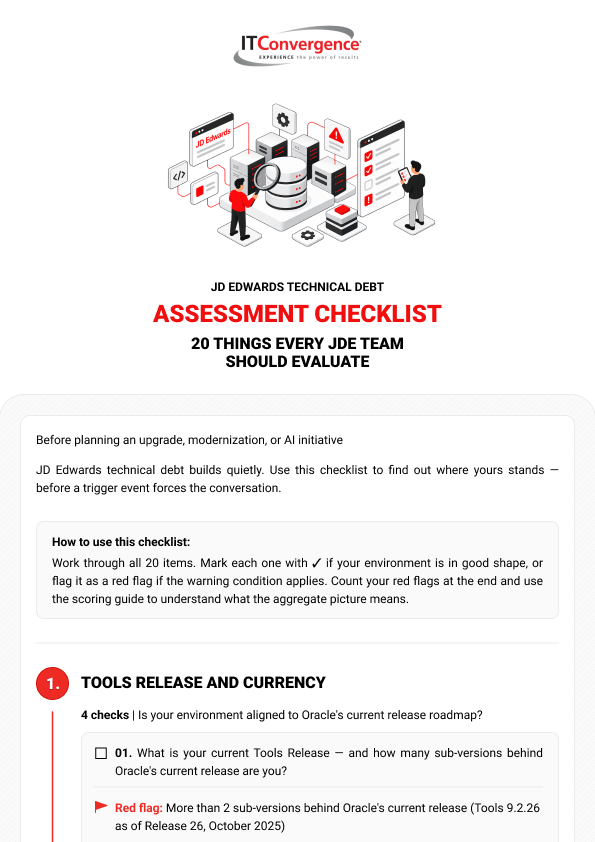
Download our infographic, “JD Edwards Technical Debt Assessment Checklist: 20 Things Every JDE Team Should Evaluate,” to assess your environment across five key areas, identify potential red flags, and establish a more informed starting point for your modernization roadmap.