
Is your warehouse operation outgrowing the way JDE WMS is currently configured?
Many JDE environments start with a basic Distribution or WMS configuration that works well at go-live. But as the business grows, new sites, channels, SKUs, and customer requirements can expose gaps in the warehouse operation.
Manual replenishment checks, paper-based picking, inventory reconciliation, and standalone labeling systems can become workarounds for capabilities that JDE WMS may already support.
The issue is often not what JDE can do. It is how much of its WMS capability has actually been configured and deployed.
Many organizations struggle with:
- Manual replenishment and paper-based picking processes
- Limited visibility into which JDE WMS capabilities are actually deployed
- Scanning processes that create data delays or manual data entry
- Customer-specific labeling requirements managed outside JDE
- Warehouse configurations that no longer match operational complexity
- Difficulty determining where to start a modernization program
The good news is that warehouse modernization does not have to mean replacing your ERP or disrupting daily operations.
A phased approach can help you assess your current WMS maturity, activate high-value capabilities, and build toward a more efficient, connected warehouse operation.
What You’ll Learn:
- How to assess your current JDE WMS maturity level
- What JDE WMS delivers through directed putaway, directed picking, replenishment, LPN tracking, and cross-docking
- How scanning and IoT devices can connect to JDE WMS through Orchestrator
- Why labeling is often underestimated and how customer-specific requirements affect configuration
- How to sequence warehouse modernization into practical phases
- What to evaluate before beginning a JDE WMS modernization project
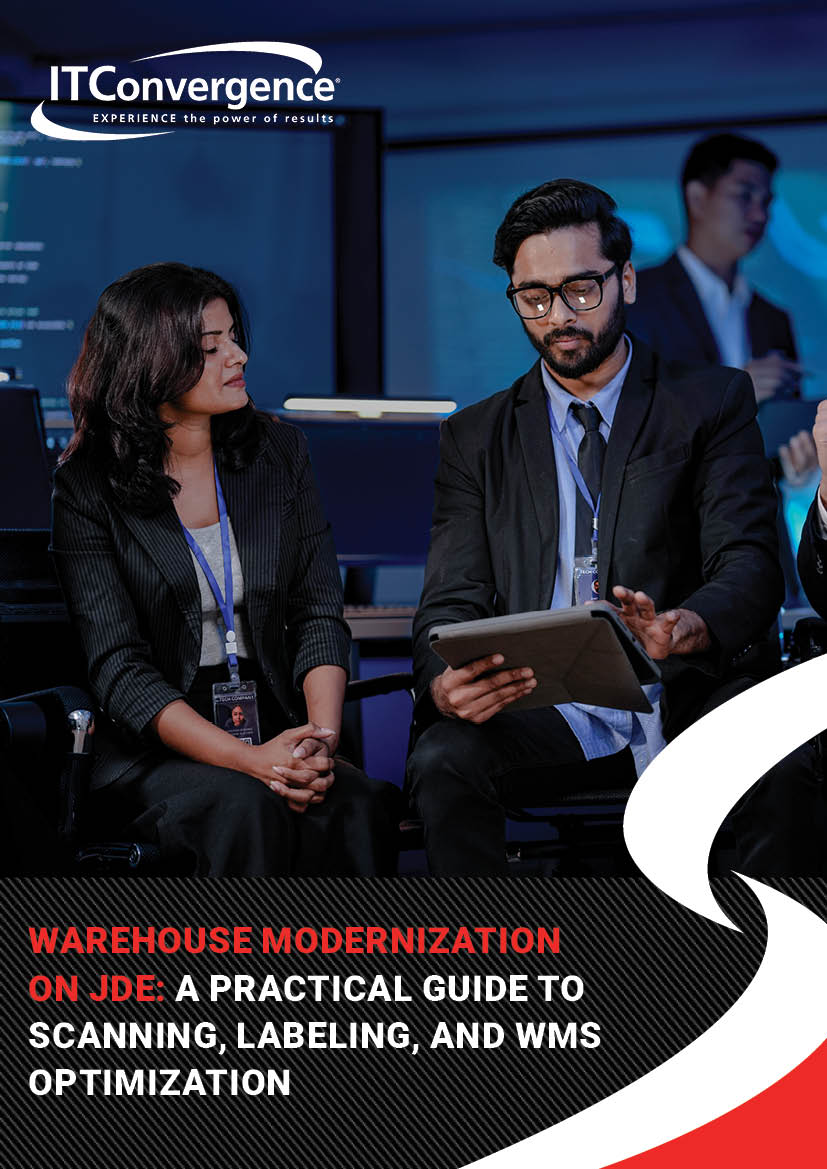
Download our ebook “Warehouse Modernization on JDE: A Practical Guide to Scanning, Labeling, and WMS Optimization” to learn how to identify the gap between your current warehouse operation and the JDE WMS capabilities available to you and build a phased modernization program that starts with current-state assessment and progresses toward advanced capabilities.